
Why Your Brain Loves Predictable Routines and How to Use Them

Have you ever wondered why making simple choices, like deciding what to eat for breakfast or choosing an outfit, can sometimes feel completely exhausting by the end of a long week? Or why sitting down with a warm cup of tea at the exact same time every afternoon brings such a profound sense of comfort? The answer lies deep within your skull. Your brain is a brilliant, highly complex organ, but it is also remarkably lazy when it comes to spending energy.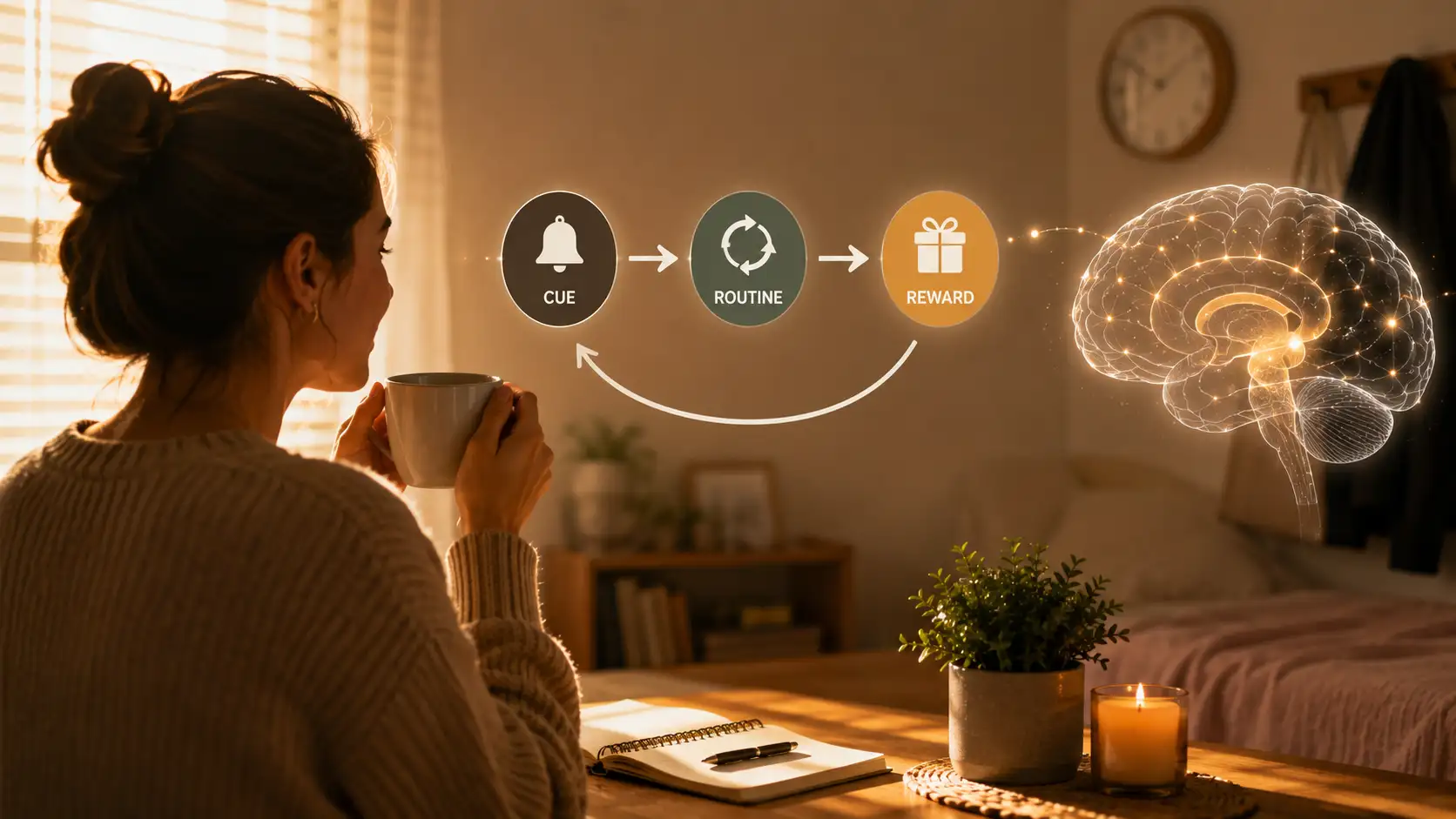
Understanding why your brain loves predictable routines isn’t just an academic exercise in neuroscience; it is the ultimate secret to reducing daily stress, sharpening your focus, and creating a healthier lifestyle without relying on fleeting willpower.
The Brain as an Energy-Saving Machine
Despite accounting for only about two per cent of your total body weight, your brain consumes nearly twenty per cent of your body’s daily energy supply. Because running this biological supercomputer is so expensive, the brain has evolved to conserve energy wherever possible.
When you encounter a brand-new situation, your prefrontal cortex, the logical, decision-making hub at the front of your head, has to work in overdrive. It evaluates risks, weighs choices, and directs your focus. However, this mental heavy lifting leads to a state known as cognitive load and decision fatigue .
To avoid burnout, the brain relies on habit loops. When you repeat a behaviour over and over in the same context, the prefrontal cortex hands off the responsibility to a deeper, more primitive structure called the basal ganglia . The basal ganglia automates actions into seamless sequences. This is why you can drive home along a familiar route without consciously thinking about every gear change or turn signal your brain has switched to autopilot to preserve precious mental fuel.
Unpacking the Habit Loop : Cue, Routine, and Reward
Every automatic behaviour is driven by a simple three-step engine known as the habit loop:
When you build predictable routines , you provide clear cues and reliable rewards. Over time, the neurological pathways for those actions widen into high-speed mental motorways.
Predictability Reduces Anxiety and Stress
Beyond saving physical energy, predictability plays a critical role in emotional regulation. Human beings are wired to seek safety, and evolutionary biology views the unknown as a potential threat. When your day lacks structure, your amygdala, the brain’s fear centre, remains on high alert, scanning for potential disruption or danger.
Establishing structured daily habits acts as an emotional anchor. When your brain knows what is coming next, it lowers its defense mechanisms. This drop in perceived threat reduces levels of cortisol (the primary stress hormone), allowing your nervous system to stay balanced, calm, and grounded throughout the day.
How to Harness Your Brain's Love for Structure
Knowing why your brain loves predictable routines gives you the blueprint to build better habits effortlessly. Here is how you can use this neuroscience to your advantage:
By designing simple, repeatable patterns, you work with your biology rather than against it, turning self-discipline into a natural, effortless way of living.
Understanding why your brain loves predictable routines isn’t just an academic exercise in neuroscience; it is the ultimate secret to reducing daily stress, sharpening your focus, and creating a healthier lifestyle without relying on fleeting willpower.
The Brain as an Energy-Saving Machine
Despite accounting for only about two per cent of your total body weight, your brain consumes nearly twenty per cent of your body’s daily energy supply. Because running this biological supercomputer is so expensive, the brain has evolved to conserve energy wherever possible.
When you encounter a brand-new situation, your prefrontal cortex, the logical, decision-making hub at the front of your head, has to work in overdrive. It evaluates risks, weighs choices, and directs your focus. However, this mental heavy lifting leads to a state known as cognitive load and decision fatigue .
You may also like
- From couture to fine jewellery: Inside Vogue Wedding Atelier 2026
- Get ₹2,500—but how? Delhi women should keep these documents ready for the application
- People Terminating Policies Before Maturity; Government Data Raises Concerns
- FSSAI Alcohol Ban: Will your favorite rum and whiskey no longer be sold? FSSAI has imposed a ban.
- Old Coins: Earn ₹10 lakh by selling old coins—did PM Modi say this in a video? Here is what the government clarified.
To avoid burnout, the brain relies on habit loops. When you repeat a behaviour over and over in the same context, the prefrontal cortex hands off the responsibility to a deeper, more primitive structure called the basal ganglia . The basal ganglia automates actions into seamless sequences. This is why you can drive home along a familiar route without consciously thinking about every gear change or turn signal your brain has switched to autopilot to preserve precious mental fuel.
Unpacking the Habit Loop : Cue, Routine, and Reward
Every automatic behaviour is driven by a simple three-step engine known as the habit loop:
- The Cue: A trigger that tells your brain to launch into automatic mode (e.g. stepping out of bed or sitting at your desk).
- The Routine: The actual behaviour or sequence of actions you perform.
- The Reward: The positive outcome or relief that reinforces the behaviour, causing the brain to release dopamine the chemical associated with pleasure and motivation.
When you build predictable routines , you provide clear cues and reliable rewards. Over time, the neurological pathways for those actions widen into high-speed mental motorways.
Predictability Reduces Anxiety and Stress
Beyond saving physical energy, predictability plays a critical role in emotional regulation. Human beings are wired to seek safety, and evolutionary biology views the unknown as a potential threat. When your day lacks structure, your amygdala, the brain’s fear centre, remains on high alert, scanning for potential disruption or danger.
Establishing structured daily habits acts as an emotional anchor. When your brain knows what is coming next, it lowers its defense mechanisms. This drop in perceived threat reduces levels of cortisol (the primary stress hormone), allowing your nervous system to stay balanced, calm, and grounded throughout the day.
How to Harness Your Brain's Love for Structure
Knowing why your brain loves predictable routines gives you the blueprint to build better habits effortlessly. Here is how you can use this neuroscience to your advantage:
- Start with Micro-Habits: Because the brain resists big, dramatic disruptions, start small. If you want to build a reading habit, read just two pages a night.
- Anchor New Behaviours: Attach a new goal to an established cue. For instance, "After I pour my morning coffee (cue), I will write down three priorities for the day (routine)."
- Reward Yourself Immediately: Celebrate small wins instantly to give your brain that crucial splash of dopamine.
By designing simple, repeatable patterns, you work with your biology rather than against it, turning self-discipline into a natural, effortless way of living.






Loving Newspoint? Download the app now
