
The Science Behind Why Fermented Dosa Batter Makes the Crispiest Dosas

A perfectly made dosa shatters at the edge and stays tender at the fold. Getting there has nothing to do with the brand of tawa or the amount of oil. It begins the night before, in a covered bowl sitting quietly on the kitchen counter.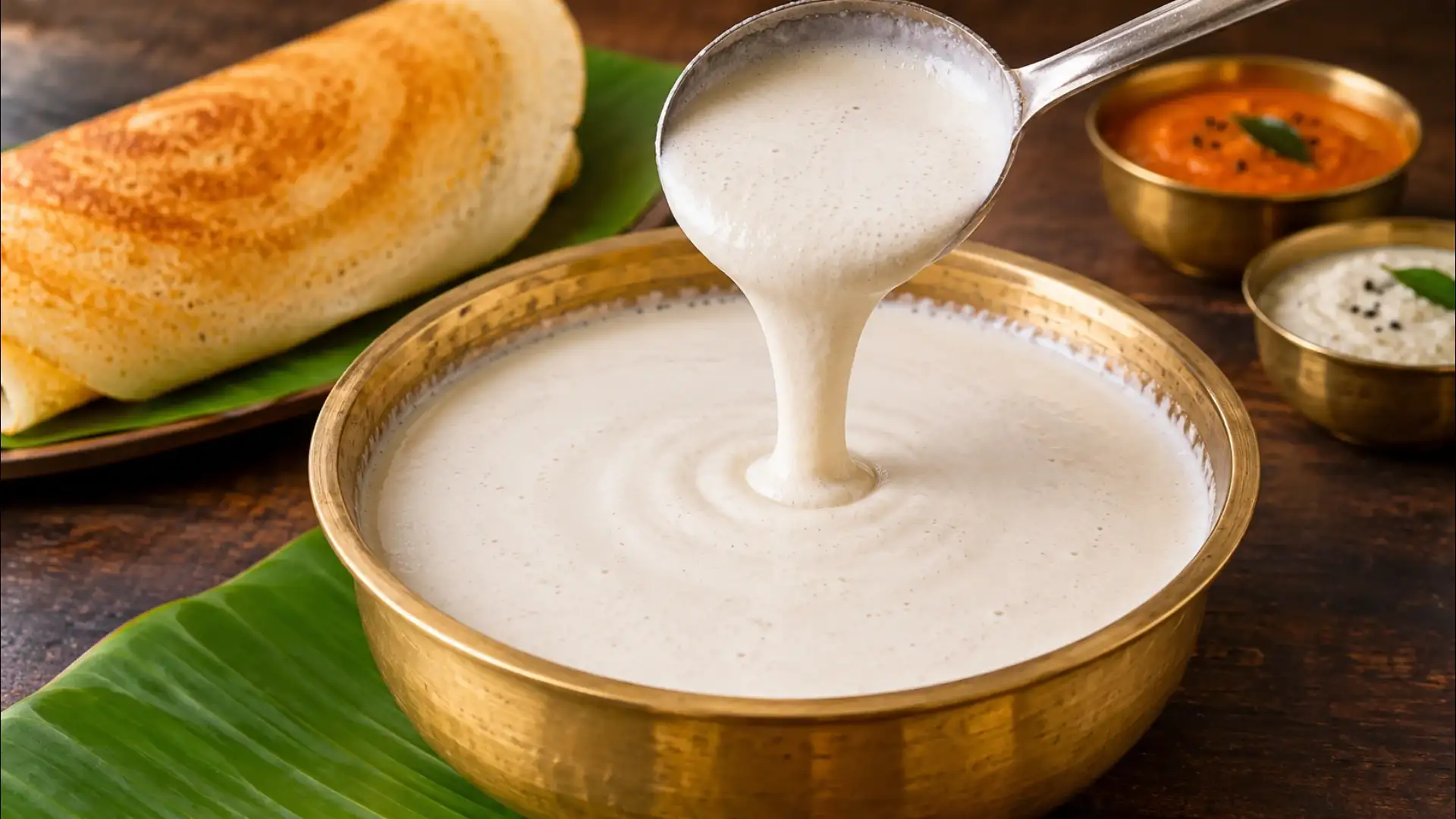
That carbon dioxide is what makes the batter rise and turn bubbly. The bubbles are not decoration. When the batter hits a hot tawa, each tiny bubble expands rapidly and then sets, leaving behind a porous, open crumb. That structure is what gives a dosa its lightness. Without fermentation, the batter spreads into a dense, flat sheet that turns chewy rather than crisp.
The sourness that develops overnight is not a flaw to be corrected. It is the signal that fermentation has done its work. A batter with no sour note at all has either not fermented long enough or has been kept too cold for the bacteria to thrive.
Refrigerating batter immediately after grinding stops fermentation almost entirely. The batter stays flat, the bubbles never form, and the dosa that comes off the pan is pale and dense. This is why traditional practice keeps the batter at room temperature for the fermentation window and refrigerates it only after it has fully risen.
Water temperature during grinding also matters. Warm water speeds fermentation but can kill the bacteria if it crosses into hot. Cold water slows things down. Water at roughly room temperature, added gradually during grinding to keep the batter from heating up in the mixer, gives the bacteria the best conditions to begin their work even before the batter is set aside.
The crunch of a good dosa is the sound of that open, porous structure meeting heat. The fermentation built the structure. The tawa only reveals it.
What Actually Happens During Fermentation
The batter for a dosa is a mix of ground rice and urad dal, both soaked separately and then combined. Left at room temperature, the batter becomes home to naturally occurring lactic acid bacteria, the same family of microbes that sour yoghurt and pickle vegetables. These bacteria, particularly Leuconostoc mesenteroides and Lactobacillus species, feed on the sugars present in the rice and lentils and release carbon dioxide as a byproduct.That carbon dioxide is what makes the batter rise and turn bubbly. The bubbles are not decoration. When the batter hits a hot tawa, each tiny bubble expands rapidly and then sets, leaving behind a porous, open crumb. That structure is what gives a dosa its lightness. Without fermentation, the batter spreads into a dense, flat sheet that turns chewy rather than crisp.
The Role of Lactic Acid
The bacteria produce more than gas. They produce lactic acid, which gradually lowers the pH of the batter. This mild acidity does two things. First, it partially breaks down the starch in the rice, making it easier for the batter to spread thin and cook through quickly. Second, it begins to soften the proteins in the urad dal, which is what gives the finished dosa its characteristic slight tang and its ability to hold together without turning brittle.The sourness that develops overnight is not a flaw to be corrected. It is the signal that fermentation has done its work. A batter with no sour note at all has either not fermented long enough or has been kept too cold for the bacteria to thrive.
You may also like
- Bigg Boss 20: Yung DSA Confesses to Cheating on Girlfriend Sameeksha Multiple Times
- 'Your access is deactivated, pack your bag and leave': Chennai manager breaks down after being asked to fire 12 employees who have worked with him for 10 years
- Ramayana Review: A Grand Blend of Indian Mythology, Technology and Powerful Performances
- At six, Ludhiana girl Sarah Sangar held a difficult seated wide-legged yoga pose on a raised gymnastics balance beam for 18 minutes and 20 seconds, earning a record entry published this week
- Cardiologist Explains the Science Behind Night Sweats and Rapid Heartbeats
Why Temperature Changes Everything
Lactic acid bacteria are most active between roughly 25°C and 35°C. In a warm kitchen, the kind found in most of coastal and southern India through most of the year, eight to twelve hours is usually enough for the batter to double in volume and develop the right level of acidity. In a cooler kitchen, the same process takes longer. Placing the batter in an oven with just the light on, or near a warm appliance, can compensate.Refrigerating batter immediately after grinding stops fermentation almost entirely. The batter stays flat, the bubbles never form, and the dosa that comes off the pan is pale and dense. This is why traditional practice keeps the batter at room temperature for the fermentation window and refrigerates it only after it has fully risen.
The Urad Dal Ratio and Why It Matters
Urad dal brings more than protein to the batter. Its outer husk carries a higher concentration of the bacteria that drive fermentation. Soaking the dal with the husk on, or using split urad with some husk remaining, gives the fermentation a stronger start. The standard ratio of roughly three parts rice to one part urad dal is not arbitrary. Too much rice and the batter lacks the microbial population and the binding proteins to hold its structure. Too much dal and the dosa turns thick and soft rather than thin and crisp.Water temperature during grinding also matters. Warm water speeds fermentation but can kill the bacteria if it crosses into hot. Cold water slows things down. Water at roughly room temperature, added gradually during grinding to keep the batter from heating up in the mixer, gives the bacteria the best conditions to begin their work even before the batter is set aside.
What the Tawa Does to the Fermented Batter
A well-fermented batter spread on a hot, lightly oiled tawa behaves differently from unfermented batter from the first second. The carbon dioxide trapped in the bubbles expands instantly. The acidified starch gelatinises quickly and evenly. The surface dries out and crisps before the interior has a chance to turn tough. The result is a dosa that is simultaneously crisp at the lacy edges, tender at the centre, and light enough to fold without cracking.The crunch of a good dosa is the sound of that open, porous structure meeting heat. The fermentation built the structure. The tawa only reveals it.






Loving Newspoint? Download the app now
