
Why Is It So Hard to Stop Doomscrolling? It’s Quietly Rewiring Your Brain

There was a time when the news arrived at your doorstep once every morning. If you missed the evening bulletin, you caught up the next day. Bad news still existed, but it had an ending. You folded the newspaper, switched off the television and got on with your life. Now, there is no ending.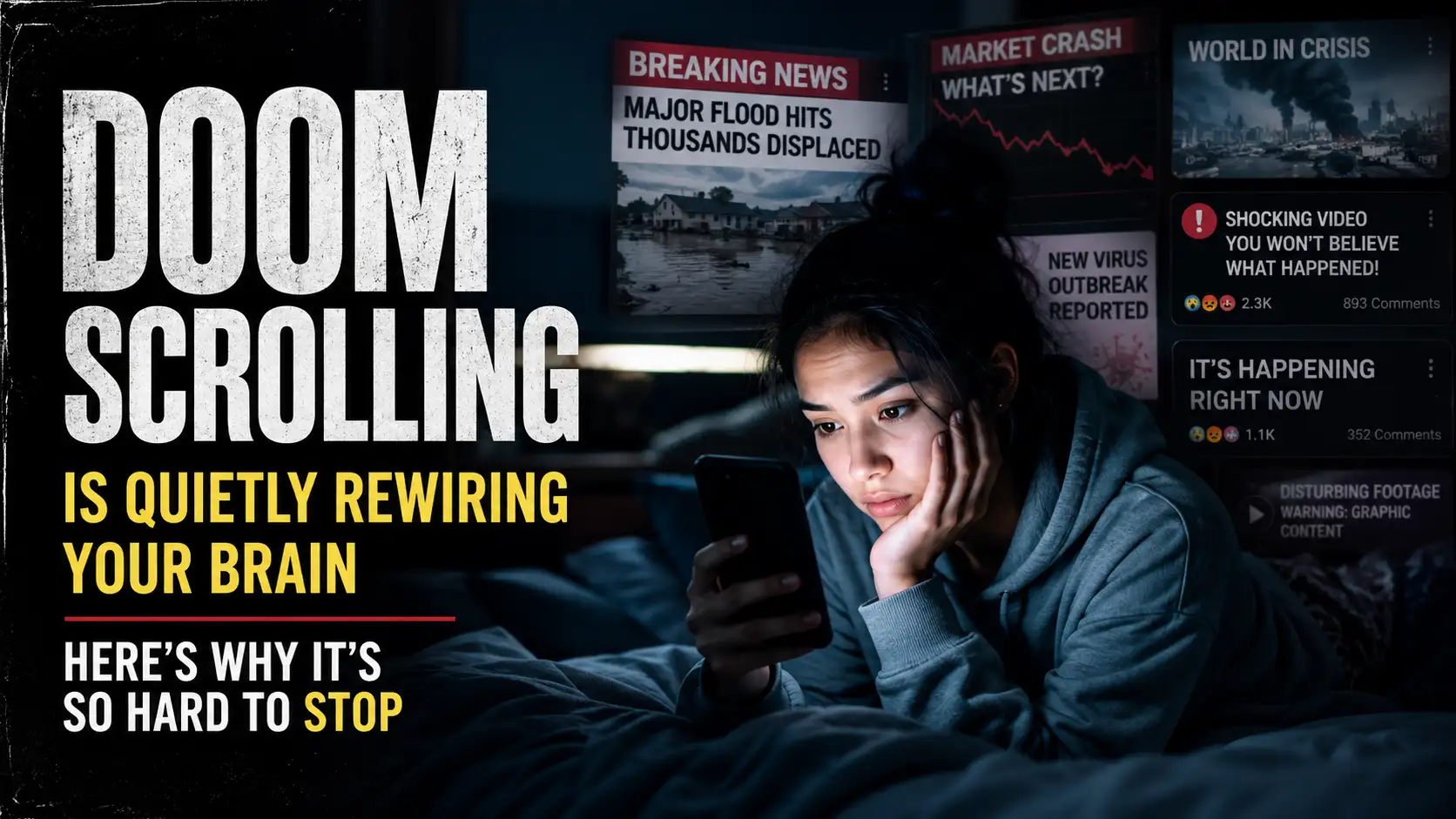
The headlines refresh every few seconds. One swipe brings another tragedy, another debate, another disaster unfolding somewhere in the world. Even after deciding you've seen enough, your thumb keeps moving almost on its own. Most people don't even realise when they're doing it. They just know that by the time they put the phone down, they feel strangely exhausted.
It's Not Really About the News
People often assume doomscrolling means being obsessed with bad news. That's only part of the story. The habit isn't about wanting negative information. It's about wanting certainty. When something worrying happens, a conflict, a natural disaster, a financial crisis or even a rumour on social media, our first instinct is to keep searching for updates. Somewhere in the back of our minds, we convince ourselves that the next article or the next video will finally make everything clearer.
It rarely does. Instead, every answer leads to another question, another notification and another headline demanding attention. Before long, you're no longer looking for information. You're simply scrolling because stopping feels harder than continuing.
Your Brain Thinks It's Helping You
This isn't just about willpower. Psychologists have long spoken about something called negativity bias, our tendency to pay more attention to potential threats than positive events. It's an instinct that helped humans survive long before smartphones existed.
Imagine hearing rustling in the bushes thousands of years ago. Ignoring it could have been dangerous. Paying attention increases your chances of staying alive.
Our brains still operate in much the same way. Only today, the "danger" isn't just about a wild animal. It's an endless stream of alarming headlines, breaking news alerts and emotionally charged videos. The brain reacts as if every update might contain something important. That's why it's so difficult to look away.
The Scroll Never Really Ends
Social media has quietly changed the way we consume information. Unlike newspapers or television broadcasts, there is no natural stopping point. Platforms are designed to keep feeding you content, one post after another, without asking whether you've had enough.
One moment you're watching a recipe. Next, you're reading about a flood. A few seconds later, you're looking at footage from a war zone. Then comes a celebrity controversy, followed by a crime report, then another breaking update. Your emotions barely have time to process one story before another arrives.
It isn't surprising that so many people close their phones feeling mentally tired without understanding why. Being Informed Shouldn't Feel Like Carrying the Weight of the World
Knowing what's happening around us helps us make better decisions, participate in public conversations and stay connected to the world. But being informed is not the same thing as being overwhelmed.
Hearing bad news repeatedly can be associated with increased stress and anxiety in some people, especially during times of major crises, research suggests. That doesn’t necessarily mean everyone will feel the same effects, but it’s a good reminder that our minds need time to process what we’re taking in. Reading every update isn't always the same as understanding it. Sometimes it's simply information overload.
Social media platforms aren't trying to upset you. They're trying to keep your attention. Every extra second you spend watching a video or reading a post tells the algorithm that you're interested. It responds by showing you more of the same.
If you've watched three videos about a breaking news event, there's a good chance your feed will offer a fourth, a fifth and a sixth. Over time, your online world can begin to feel far darker than reality itself. That's not because the world contains only bad news. It's because the algorithm has learned what keeps you scrolling.
Deleting every social media app isn't the answer for most people. Neither is pretending bad things don't happen. The healthier one is learning that eating information with intention beats impulse. Choose a handful of trusted news sources rather than endless feeds. Decide when you'll check the news instead of refreshing your phone every few minutes. And if you notice yourself scrolling without remembering what you're even looking for, that's probably your cue to stop.
The world won't become clearer because you spent another hour reading headlines. Sometimes, the most informed decision you can make is knowing when you've had enough.
The next time you reach for your phone before going to bed, pay attention to the promise you make yourself. "Just five minutes." For many of us, that's where doomscrolling begins. Not because we're careless. Not because we're addicted to bad news.
But because we're human. We want answers. We want certainty. We want to believe that one more headline will make the world make a little more sense. Most nights, it doesn't. And maybe the healthiest thing we can do isn't to know everything before we sleep. Maybe it's to accept that some stories can wait until morning.
The headlines refresh every few seconds. One swipe brings another tragedy, another debate, another disaster unfolding somewhere in the world. Even after deciding you've seen enough, your thumb keeps moving almost on its own. Most people don't even realise when they're doing it. They just know that by the time they put the phone down, they feel strangely exhausted.
It's Not Really About the News
People often assume doomscrolling means being obsessed with bad news. That's only part of the story. The habit isn't about wanting negative information. It's about wanting certainty. When something worrying happens, a conflict, a natural disaster, a financial crisis or even a rumour on social media, our first instinct is to keep searching for updates. Somewhere in the back of our minds, we convince ourselves that the next article or the next video will finally make everything clearer.
It rarely does. Instead, every answer leads to another question, another notification and another headline demanding attention. Before long, you're no longer looking for information. You're simply scrolling because stopping feels harder than continuing.
Your Brain Thinks It's Helping You
This isn't just about willpower. Psychologists have long spoken about something called negativity bias, our tendency to pay more attention to potential threats than positive events. It's an instinct that helped humans survive long before smartphones existed.
Imagine hearing rustling in the bushes thousands of years ago. Ignoring it could have been dangerous. Paying attention increases your chances of staying alive.
Our brains still operate in much the same way. Only today, the "danger" isn't just about a wild animal. It's an endless stream of alarming headlines, breaking news alerts and emotionally charged videos. The brain reacts as if every update might contain something important. That's why it's so difficult to look away.
The Scroll Never Really Ends
Social media has quietly changed the way we consume information. Unlike newspapers or television broadcasts, there is no natural stopping point. Platforms are designed to keep feeding you content, one post after another, without asking whether you've had enough.
One moment you're watching a recipe. Next, you're reading about a flood. A few seconds later, you're looking at footage from a war zone. Then comes a celebrity controversy, followed by a crime report, then another breaking update. Your emotions barely have time to process one story before another arrives.
You may also like
- White Vinegar Can Make Old Towels Feel Softer Again, and Most People Never Think to Try It
- Five minutes of lemon steam does what scrubbing a microwave can't
- There's a hidden reason why most laundry detergents are blue, and it has nothing to do with cleaning power
- What your favourite lipstick shade says about your personality
- Dengue During Pregnancy In Monsoon: Is It Dangerous and How to Stay Safe?
It isn't surprising that so many people close their phones feeling mentally tired without understanding why. Being Informed Shouldn't Feel Like Carrying the Weight of the World
Following the news is important
Knowing what's happening around us helps us make better decisions, participate in public conversations and stay connected to the world. But being informed is not the same thing as being overwhelmed.
Hearing bad news repeatedly can be associated with increased stress and anxiety in some people, especially during times of major crises, research suggests. That doesn’t necessarily mean everyone will feel the same effects, but it’s a good reminder that our minds need time to process what we’re taking in. Reading every update isn't always the same as understanding it. Sometimes it's simply information overload.
Algorithms Don't Know When You've Had Enough
Social media platforms aren't trying to upset you. They're trying to keep your attention. Every extra second you spend watching a video or reading a post tells the algorithm that you're interested. It responds by showing you more of the same.
If you've watched three videos about a breaking news event, there's a good chance your feed will offer a fourth, a fifth and a sixth. Over time, your online world can begin to feel far darker than reality itself. That's not because the world contains only bad news. It's because the algorithm has learned what keeps you scrolling.
Breaking the Habit Doesn't Mean Ignoring Reality
Deleting every social media app isn't the answer for most people. Neither is pretending bad things don't happen. The healthier one is learning that eating information with intention beats impulse. Choose a handful of trusted news sources rather than endless feeds. Decide when you'll check the news instead of refreshing your phone every few minutes. And if you notice yourself scrolling without remembering what you're even looking for, that's probably your cue to stop.
The world won't become clearer because you spent another hour reading headlines. Sometimes, the most informed decision you can make is knowing when you've had enough.
Maybe the Last Scroll Can Wait
The next time you reach for your phone before going to bed, pay attention to the promise you make yourself. "Just five minutes." For many of us, that's where doomscrolling begins. Not because we're careless. Not because we're addicted to bad news.
But because we're human. We want answers. We want certainty. We want to believe that one more headline will make the world make a little more sense. Most nights, it doesn't. And maybe the healthiest thing we can do isn't to know everything before we sleep. Maybe it's to accept that some stories can wait until morning.






Loving Newspoint? Download the app now
