
Socotra: The Island That Looks Like Another Planet

Socotra sits in the Arabian Sea, roughly 240 kilometres east of the Horn of Africa and 380 kilometres south of the Arabian Peninsula. Its isolation is not a recent accident.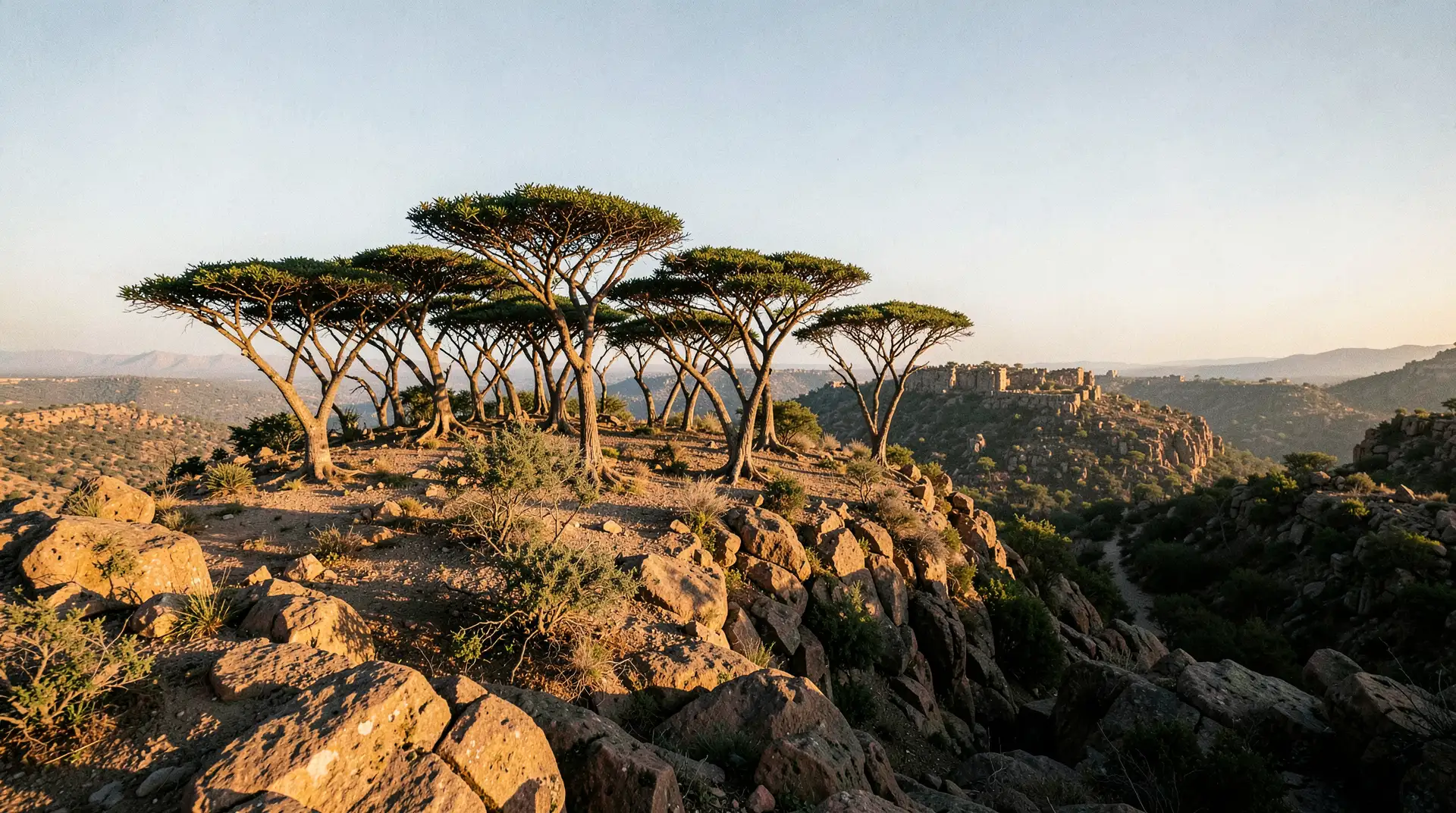
The ancient supercontinent Gondwana began breaking up over 150 million years ago, and around 20 million years ago as oceanic crust formed in the Gulf of Aden Socotra's separation from the surrounding landmass was completed. Ocean waters kept it sealed long enough for evolution to run its own experiment. The result is a landscape that looks designed rather than grown, and a biological record unlike almost anywhere else on the planet.
The shape is not decorative; it channels morning mist downward to the roots in an environment that receives almost no rain for most of the year.
Slice the bark and a deep crimson resin seeps out, which traders across the ancient world valued as a dye, a varnish, and a medicine. Arab, Greek, and Roman merchants knew it.
The tree itself is found almost nowhere else. Socotra holds 307 endemic plant species about 37% of its roughly 825 known plant species that grow nowhere else on Earth, and the dragon blood tree is the most striking of them. Walking among a grove of them on the Dixam Plateau feels genuinely disorienting; the trees are real, but the scene reads as theatre.
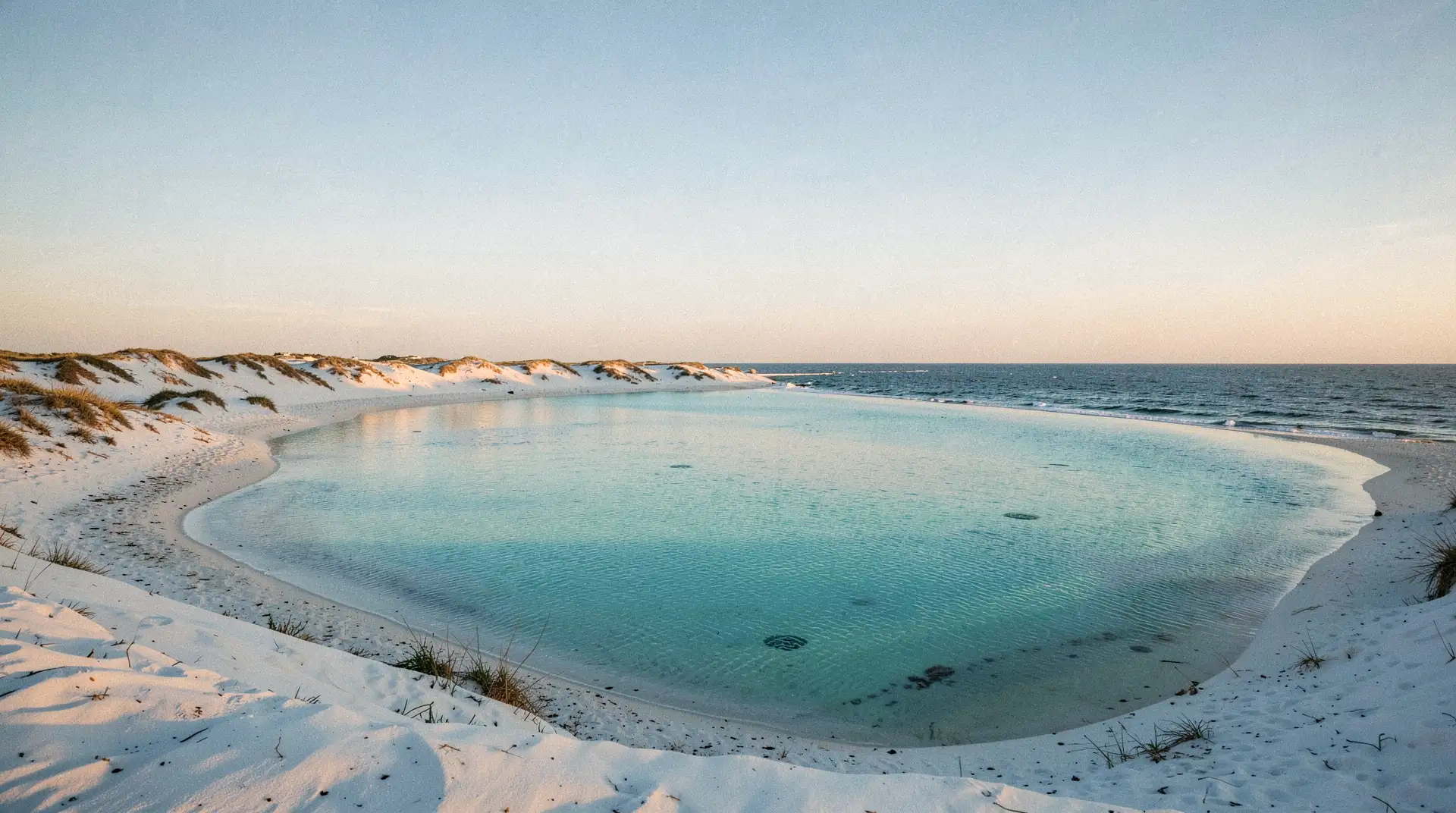
Closer to the coast, the land flattens into sand dunes that push right to the water's edge at places like Arher, where a freshwater spring feeds a lagoon before it meets the sea.
The beaches are white and largely empty. The water runs between pale turquoise and deep blue depending on depth and time of day.
Detwah Lagoon, near the western town of Qalansiyah, is one of the most photographed stretches of coastline in the region, a calm, shallow bay ringed by dunes, with almost no infrastructure around it. The contrast between the arid interior and the coast is one of the island's defining qualities.
 Roughly a third of Socotra's plant species are endemic, meaning they grow here and nowhere else. The same isolation that shaped the trees shaped the insects, the birds, and the reptiles.
The island has its own species of starling, its own species of sunbird, and several reptiles found only within its shores.
UNESCO designated Socotra a World Heritage Site in 2008, citing its outstanding universal value as a biodiversity hotspot. The comparison made at the time was to the Galápagos Islands, another place where isolation produced life that seems to have arrived from a different evolutionary timeline.
The comparison holds. Both places reward the same kind of attention: slow, curious, and willing to be surprised by small things.
The island's main town, Hadibo, has a market, a port, and the practical business of a working settlement. Most of the population lives in small coastal villages or in the mountains.
Fishing is central to daily life, and the boats used are sometimes still built in traditional styles. Visitors who spend time in the villages rather than only at the famous landscapes tend to leave with a more complete picture of the place.
The political situation in Yemen has made access complicated and variable over the years, and anyone planning a visit should check current conditions through their government's travel advisory before making any arrangements.
The island has limited infrastructure. Accommodation is mostly basic guesthouses and camping. There are no large resort chains. The roads that exist are few, and reaching the interior requires a four-wheel-drive vehicle.
Guided tours arranged through operators with local knowledge are the standard way to navigate the island safely and responsibly. The remoteness is part of the experience, but it requires preparation rather than impulse.
Socotra rewards the traveller who arrives with patience rather than a checklist. The dragon blood trees are worth the journey on their own. The beaches and lagoons add a second layer.
The language, the fishing culture, and the quiet strangeness of a place that evolved in near-total isolation add a third. It is one of the few destinations where the description, however vivid, genuinely undersells the thing itself.
The ancient supercontinent Gondwana began breaking up over 150 million years ago, and around 20 million years ago as oceanic crust formed in the Gulf of Aden Socotra's separation from the surrounding landmass was completed. Ocean waters kept it sealed long enough for evolution to run its own experiment. The result is a landscape that looks designed rather than grown, and a biological record unlike almost anywhere else on the planet.
The Tree That Bleeds Red
The dragon blood tree is Socotra's most recognisable feature, and it earns every photograph taken of it. Its canopy spreads like an inside-out umbrella, flat and dense, with the trunk branching only near the top.The shape is not decorative; it channels morning mist downward to the roots in an environment that receives almost no rain for most of the year.
Slice the bark and a deep crimson resin seeps out, which traders across the ancient world valued as a dye, a varnish, and a medicine. Arab, Greek, and Roman merchants knew it.
The tree itself is found almost nowhere else. Socotra holds 307 endemic plant species about 37% of its roughly 825 known plant species that grow nowhere else on Earth, and the dragon blood tree is the most striking of them. Walking among a grove of them on the Dixam Plateau feels genuinely disorienting; the trees are real, but the scene reads as theatre.
A Desert That Meets the Sea
Socotra's geography moves through extremes within short distances. The interior rises into granite mountains that catch cloud and stay relatively cool. Below them, the Dixam Plateau carries the dragon blood forests.Closer to the coast, the land flattens into sand dunes that push right to the water's edge at places like Arher, where a freshwater spring feeds a lagoon before it meets the sea.
The beaches are white and largely empty. The water runs between pale turquoise and deep blue depending on depth and time of day.
Detwah Lagoon, near the western town of Qalansiyah, is one of the most photographed stretches of coastline in the region, a calm, shallow bay ringed by dunes, with almost no infrastructure around it. The contrast between the arid interior and the coast is one of the island's defining qualities.
The Biology That Makes Scientists Pay Attention
The island has its own species of starling, its own species of sunbird, and several reptiles found only within its shores.
UNESCO designated Socotra a World Heritage Site in 2008, citing its outstanding universal value as a biodiversity hotspot. The comparison made at the time was to the Galápagos Islands, another place where isolation produced life that seems to have arrived from a different evolutionary timeline.
The comparison holds. Both places reward the same kind of attention: slow, curious, and willing to be surprised by small things.
You may also like
- 'Unauthorised persons in command': Cargo ship hijacked off Yemen coast
- A California man paid $240,000 after being caught impersonating a therapist; years later, he sought to recover the money after his conviction was vacated, but an appeals court reversed that order and revived the company's fraud claim
- India key partner in shaping sustainable, secure world: Danish Foreign Minister
- US Republicans may join Democrats to challenge Trump's sweeping tariff policies
- Several students killed in explosion at school in Afghanistan's Kunar province
The Socotri People and Their Language
Socotra is inhabited, and has been for thousands of years. The Socotri people speak a language, Socotri, that belongs to the Modern South Arabian language family. It is primarily an oral tradition passed through speech without a long-standing everyday writing system making it one of the more fragile linguistic traditions in the world, even as linguists and researchers work with phonetic transcriptions and an Arabic-script orthography adopted in 2014 to document it.The island's main town, Hadibo, has a market, a port, and the practical business of a working settlement. Most of the population lives in small coastal villages or in the mountains.
Fishing is central to daily life, and the boats used are sometimes still built in traditional styles. Visitors who spend time in the villages rather than only at the famous landscapes tend to leave with a more complete picture of the place.
What Reaching Socotra Actually Involves
Socotra is remote in the practical sense, not only the romantic one. Access is by air through Hadibo's small airport, with connections typically routed through the UAE or Yemen.The political situation in Yemen has made access complicated and variable over the years, and anyone planning a visit should check current conditions through their government's travel advisory before making any arrangements.
The island has limited infrastructure. Accommodation is mostly basic guesthouses and camping. There are no large resort chains. The roads that exist are few, and reaching the interior requires a four-wheel-drive vehicle.
Guided tours arranged through operators with local knowledge are the standard way to navigate the island safely and responsibly. The remoteness is part of the experience, but it requires preparation rather than impulse.
Socotra rewards the traveller who arrives with patience rather than a checklist. The dragon blood trees are worth the journey on their own. The beaches and lagoons add a second layer.
The language, the fishing culture, and the quiet strangeness of a place that evolved in near-total isolation add a third. It is one of the few destinations where the description, however vivid, genuinely undersells the thing itself.






Loving Newspoint? Download the app now
