
Strait of Crisis: Retaliatory Air Strikes Shake Iran Amid Funeral Mourning

A dangerous escalation has gripped the Middle East following a series of coordinated maritime attacks in the strategically vital Strait of Hormuz , prompting a major targeted military response from the United States. Within a span of just 24-hours, three commercial tankers, including a Qatari Liquefied Gas (LNG) carrier named Al Rekayyat, were struck by projectiles and uncrewed aerial vehicles off the coast of Oman. The attacks have severely disrupted one of the world’s busiest maritime trade routes, ending a fragile period of relative calm in the region and sending global energy markets into renewed volatility.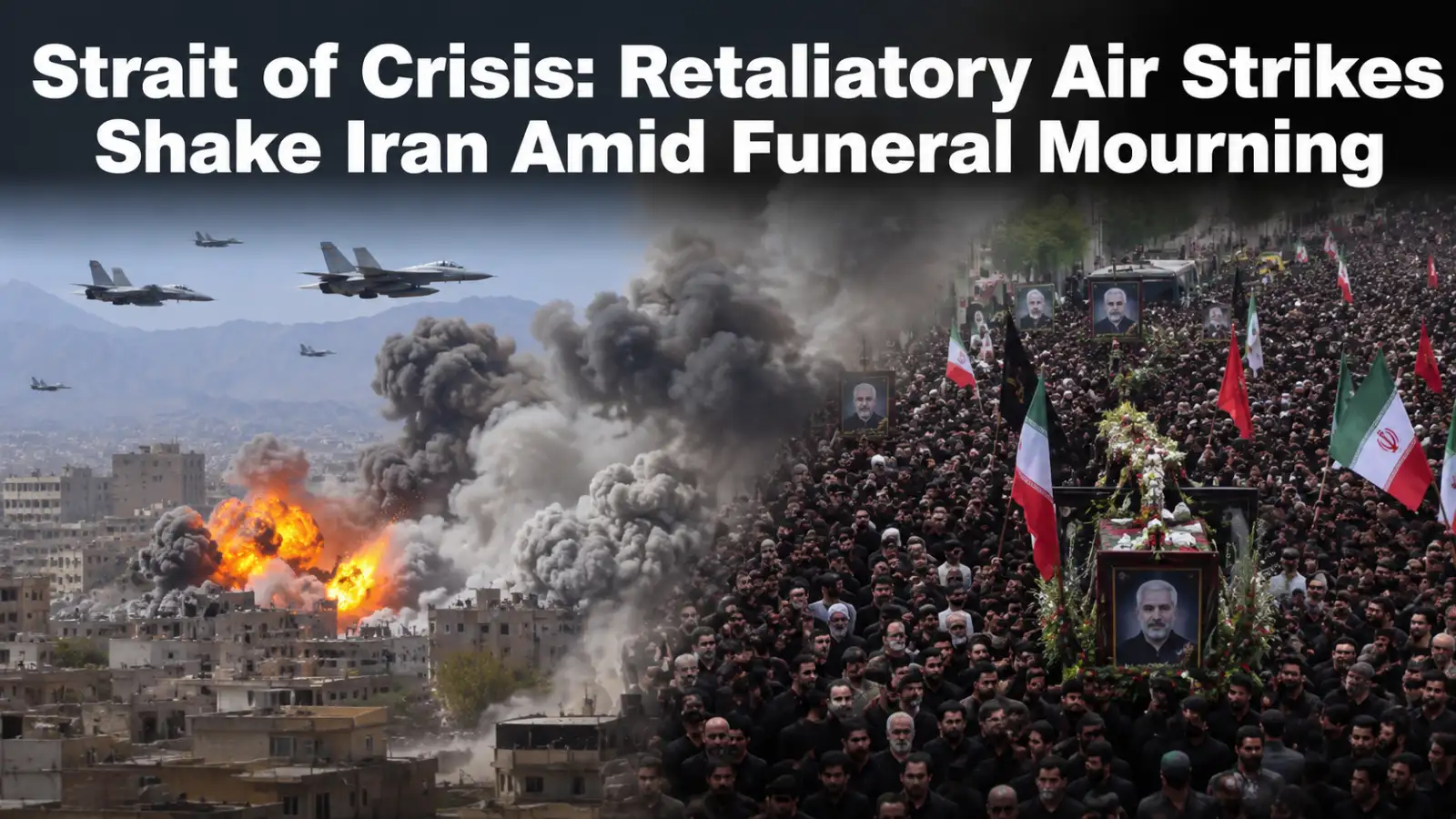
According to the British military's maritime monitoring group, the United Kingdom Maritime Trade Operations (UKMTO), at least one vessel suffered a structural fire after being struck by an unknown drone. Fortunately, no crew casualties or severe environmental contamination have been reported.
The political fallout was immediate. Qatar strongly condemned the operation, directly attributing the aggression to Iranian forces and calling the sabotage an unacceptable violation of international laws governing safe navigation. Maritime security experts noted that the incidents marked the first notable hostilities in the vital waterway since the start of the extended national mourning period following the death of Iran's late Supreme Leader, Ayatollah Ali Khamenei, earlier this year. As millions of mourners gathered in the holy city of Qom to pay their final respects, Iranian officials adopted a hardline stance, warning that they would withdraw from ongoing regional peace negotiations unless the United States ended its overt threats of escalating the conflict.
In direct retaliation for the maritime disruption, United States Central Command launched a series of powerful air and missile strikes across southern Iran. According to senior American military sources, the operation was intended to degrade Iran's coastal warfare capabilities by targeting anti-ship cruise missile units, surface-to-air missile batteries, coastal radar surveillance infrastructure, and active drone launch facilities. Simultaneously, the White House intensified economic pressure by revoking a critical, temporary sanctions waiver previously granted for Iranian oil exports, effectively restricting Tehran’s primary source of foreign revenue just as bilateral conflict resolution talks hung in the balance.
The impact of the American counter-offensive was felt acutely along Iran's southern coastlines, where State media reported numerous large explosions at strategic military and economic sites. According to local reports, at least six explosions were heard on Qeshm Island, seven near the coastal town of Sirik, and several more in the major port city of Bandar Abbas. Responding through official media channels, Iran’s Foreign Ministry accused Washington of violating existing agreements and threatening that Tehran would implement definitive actions to protect its national sovereignty and strategic assets from foreign interference.
Historically, the Strait of Hormuz functions as the world's most critical maritime oil transit channel. Positioned between Oman and Iran, the narrow passage links the Persian Gulf oil fields to global markets, seeing roughly twenty per cent of the world's petroleum and a substantial portion of global LNG supplies move through its shipping lanes daily. Disruptions here inevitably trigger worldwide panic regarding supply stability. Because the passage is geographically tight, commercial vessels are uniquely vulnerable to asymmetric warfare tactics, including drone deployments and sea-mine placement, which explains why a joint British and French task force proposal for an international naval escort mechanism is currently being urgently reviewed by NATO foreign ministers and their Gulf Arab allies at a special summit in Ankara.
Amidst the naval conflict, secondary diplomatic channels remain active elsewhere in the region. Israeli Foreign Minister Gideon Saar verified that despite the surrounding regional turmoil, structural peace discussions with Lebanon are moving forward. Delegations from both countries are scheduled to meet at the ambassadorial level in Rome on July 15 and 16 to solidify a framework agreement brokered with American assistance. While the marine war zone near Iran threatens an expanded global economic shock, separate diplomatic tracks continue to try to insulate the Levant from total crisis.
According to the British military's maritime monitoring group, the United Kingdom Maritime Trade Operations (UKMTO), at least one vessel suffered a structural fire after being struck by an unknown drone. Fortunately, no crew casualties or severe environmental contamination have been reported.
The political fallout was immediate. Qatar strongly condemned the operation, directly attributing the aggression to Iranian forces and calling the sabotage an unacceptable violation of international laws governing safe navigation. Maritime security experts noted that the incidents marked the first notable hostilities in the vital waterway since the start of the extended national mourning period following the death of Iran's late Supreme Leader, Ayatollah Ali Khamenei, earlier this year. As millions of mourners gathered in the holy city of Qom to pay their final respects, Iranian officials adopted a hardline stance, warning that they would withdraw from ongoing regional peace negotiations unless the United States ended its overt threats of escalating the conflict.
You may also like
- 'Trump misread India': Former NSA John Bolton tears apart Pakistan playbook
- Indonesian President Subianto sees off PM Modi as he emplanes for Australia
- Awami League flags 61 custodial deaths in Bangladesh during first six months of 2026
- Prince Harry loses privacy case against 'Daily Mail' publisher
- Paris Hilton is celebrating the closure of a 55-year-old school in Utah: Inside her long-time battle against the boarding school and why
In direct retaliation for the maritime disruption, United States Central Command launched a series of powerful air and missile strikes across southern Iran. According to senior American military sources, the operation was intended to degrade Iran's coastal warfare capabilities by targeting anti-ship cruise missile units, surface-to-air missile batteries, coastal radar surveillance infrastructure, and active drone launch facilities. Simultaneously, the White House intensified economic pressure by revoking a critical, temporary sanctions waiver previously granted for Iranian oil exports, effectively restricting Tehran’s primary source of foreign revenue just as bilateral conflict resolution talks hung in the balance.
The impact of the American counter-offensive was felt acutely along Iran's southern coastlines, where State media reported numerous large explosions at strategic military and economic sites. According to local reports, at least six explosions were heard on Qeshm Island, seven near the coastal town of Sirik, and several more in the major port city of Bandar Abbas. Responding through official media channels, Iran’s Foreign Ministry accused Washington of violating existing agreements and threatening that Tehran would implement definitive actions to protect its national sovereignty and strategic assets from foreign interference.
Historically, the Strait of Hormuz functions as the world's most critical maritime oil transit channel. Positioned between Oman and Iran, the narrow passage links the Persian Gulf oil fields to global markets, seeing roughly twenty per cent of the world's petroleum and a substantial portion of global LNG supplies move through its shipping lanes daily. Disruptions here inevitably trigger worldwide panic regarding supply stability. Because the passage is geographically tight, commercial vessels are uniquely vulnerable to asymmetric warfare tactics, including drone deployments and sea-mine placement, which explains why a joint British and French task force proposal for an international naval escort mechanism is currently being urgently reviewed by NATO foreign ministers and their Gulf Arab allies at a special summit in Ankara.
Amidst the naval conflict, secondary diplomatic channels remain active elsewhere in the region. Israeli Foreign Minister Gideon Saar verified that despite the surrounding regional turmoil, structural peace discussions with Lebanon are moving forward. Delegations from both countries are scheduled to meet at the ambassadorial level in Rome on July 15 and 16 to solidify a framework agreement brokered with American assistance. While the marine war zone near Iran threatens an expanded global economic shock, separate diplomatic tracks continue to try to insulate the Levant from total crisis.






Loving Newspoint? Download the app now
