
US Presidents Who Survived Assassination Attempts: From Andrew Jackson to Donald Trump

The history of American politics is marked by moments of extraordinary vulnerability, none more dramatic than when a commander-in-chief survives an assassination attempt. While the assassinations of Abraham Lincoln, James A. Garfield, William McKinley, and John F. Kennedy remain deeply etched in the nation's memory, the stories of the presidents who escaped death offer a compelling glimpse into chance, resilience, and pivotal moments that altered the course of history.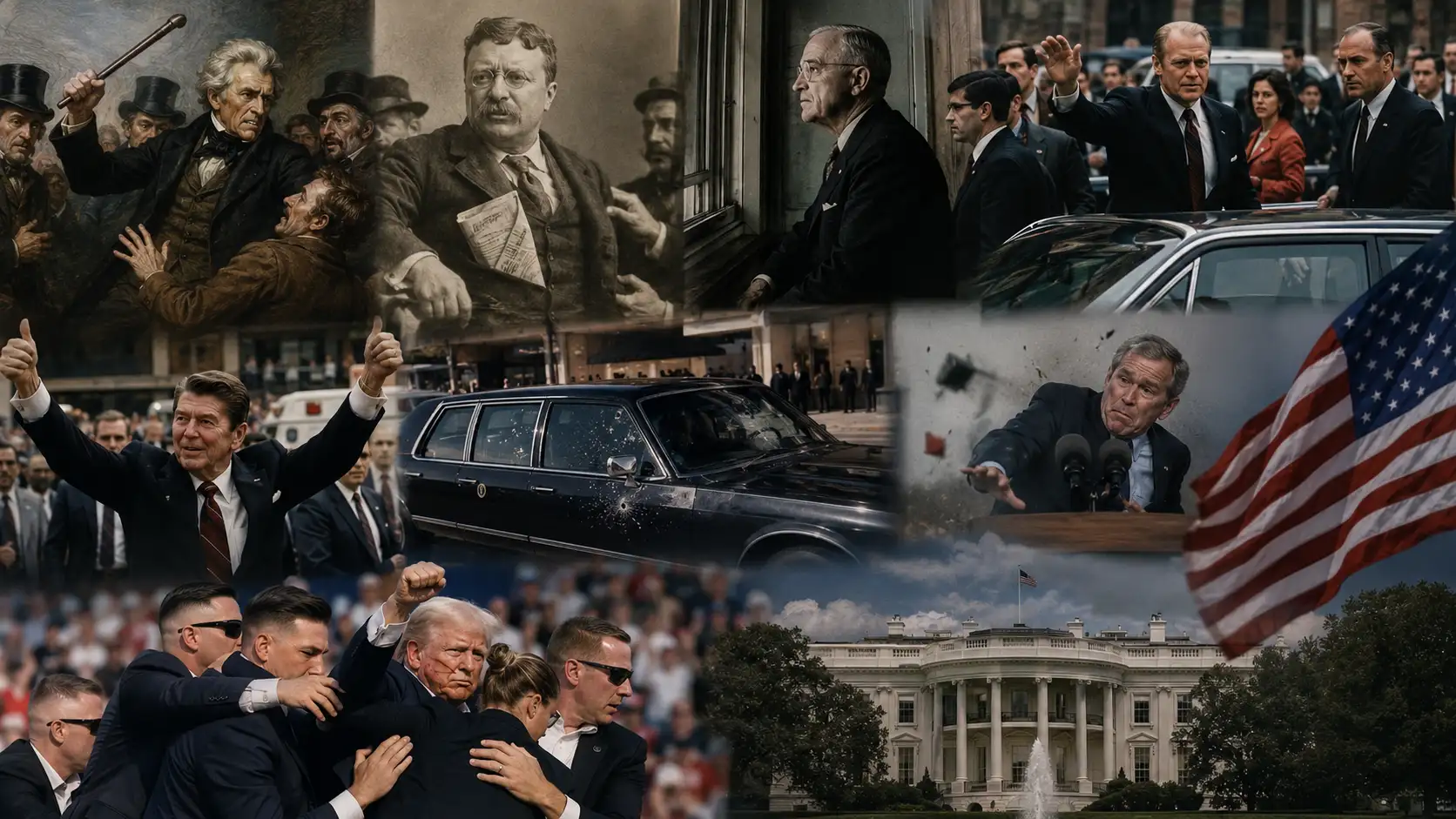
From the early days of the republic to the modern Secret Service era, these failed assassination attempts have shaped not only individual presidencies but also the evolution of presidential security across the United States.
Nearly eight decades later, Theodore Roosevelt proved his legendary toughness during a 1912 campaign stop in Milwaukee. Running for a non-consecutive third term as the Progressive Party’s "Bull Moose" candidate, Roosevelt was shot in the chest by John Schrank. Fortunately, the bullet was slowed by a metal eyeglasses case and a dense, 50-page copy of his speech tucked into his jacket. After realising that he wasn’t coughing up blood, Roosevelt addressed the stunned crowd, declaring, "It takes more than that to kill a Bull Moose." Hen then went on to deliver his 90-minute speech before finally seeking medical treatment.
Close Calls in the Mid-Century: Harry S. Truman and Gerald Ford
In 1950, Harry S. Truman survived a violent attack on Blair House, where he was staying while the White House was undergoing renovations. Two Puerto Rican nationalists attempted to storm the residence, triggering a fierce gunfight on the front steps. The clash claimed the lives of a White House police officer and one of the attackers. Truman, who watched the incident unfold from a second-story window, escaped unharmed but was deeply affected by the sacrifice of the officers protecting him.
The 1970s saw Gerald Ford survive two separate assassination attempts within just 17 days in September 1975. Both incidents took place in California. The first occurred in Sacramento, where Lynette "Squeaky" Fromme, a follower of Charles Manson, pointed a pistol at Ford, but the weapon failed to fire because there was no bullet in the chamber. Just 17 days later in San Francisco, Sara Jane Moore fired a shot at the president, but a quick-thinking bystander grabbed her arm at the last moment, causing the bullet to miss Ford by inches.
Modern Eras and Changing Fortunes: Ronald Reagan to Donald Trump
Perhaps the most consequential assassination attempt in modern American history occurred in 1981, when Ronald Reagan was shot by John Hinckley Jr. outside a hotel in Washington, D.C. The bullet ricocheted off the presidential limousine and punctured Reagan's lung, stopping mere inches from his heart. Reagan's good humor under pressure telling surgeons "I hope you are all Republicans"- boosted his national popularity and solidified the modern, ultra-stringent protocols of the Secret Service.
In the 21st century, the threat landscape evolved from lone-wolf attackers to complex global and domestic security risks. In 2005, George W. Bush survived an assassination attempt during a speech in Tbilisi, Georgia, when an attacker hurled a live grenade toward the stage. Fortunately, the grenade failed to detonate, allowing him to escape unhurt.
More recently, political violence once again came into sharp focus when Donald Trump survived an assassination attempt during a 2024 campaign rally in Butler, Pennsylvania. A gunman's bullet grazed his right ear, narrowly missing a fatal strike. The incident, along with other alleged plots uncovered later, underscored that the threat of political violence remains a persistent and volatile challenge in contemporary American politics.
Every surviving assassination attempt on a president serves as a stark reminder of the fragile line separating stability from chaos. Although these moments were born out of violence and malice, the survival of these leaders ultimately reinforced the continuity of the American government, proving that the office of the president is larger than the violence directed against it.
From the early days of the republic to the modern Secret Service era, these failed assassination attempts have shaped not only individual presidencies but also the evolution of presidential security across the United States.
The Miraculous and the Bizarre: Andrew Jackson and Theodore Roosevelt
The first recorded attempt on a sitting U.S. President took place in 1835, when Andrew Jackson became the target. As he was leaving a congressional funeral at the U.S. Capitol, an unemployed house painter named Richard Lawrence pulled out a pistol and fired - but it misfired. Lawrence immediately drew a second pistol, which also failed to fire. Experts later calculated the odds of both functioning weapons misfiring one after the other at nearly 125,000 to 1. Furious, 67-year-old Jackson reportedly attacked Lawrence with his cane before aides and bystanders restrained the would-be assassin.Nearly eight decades later, Theodore Roosevelt proved his legendary toughness during a 1912 campaign stop in Milwaukee. Running for a non-consecutive third term as the Progressive Party’s "Bull Moose" candidate, Roosevelt was shot in the chest by John Schrank. Fortunately, the bullet was slowed by a metal eyeglasses case and a dense, 50-page copy of his speech tucked into his jacket. After realising that he wasn’t coughing up blood, Roosevelt addressed the stunned crowd, declaring, "It takes more than that to kill a Bull Moose." Hen then went on to deliver his 90-minute speech before finally seeking medical treatment.
Close Calls in the Mid-Century: Harry S. Truman and Gerald Ford
In 1950, Harry S. Truman survived a violent attack on Blair House, where he was staying while the White House was undergoing renovations. Two Puerto Rican nationalists attempted to storm the residence, triggering a fierce gunfight on the front steps. The clash claimed the lives of a White House police officer and one of the attackers. Truman, who watched the incident unfold from a second-story window, escaped unharmed but was deeply affected by the sacrifice of the officers protecting him.
You may also like
- Sheikh Hasina says she'll return to Bangladesh in December
- China striking economic deals in Sudan under cover of peace rhetoric: Report
- India, Australia sign Traditional Knowledge Digital Library access pact to strengthen patent examination
- Balochistan 'ablaze', law and order at critical level: Baloch activist
- Seafarers attacked in Strait of Hormuz sue shipping company in Thailand
The 1970s saw Gerald Ford survive two separate assassination attempts within just 17 days in September 1975. Both incidents took place in California. The first occurred in Sacramento, where Lynette "Squeaky" Fromme, a follower of Charles Manson, pointed a pistol at Ford, but the weapon failed to fire because there was no bullet in the chamber. Just 17 days later in San Francisco, Sara Jane Moore fired a shot at the president, but a quick-thinking bystander grabbed her arm at the last moment, causing the bullet to miss Ford by inches.
Modern Eras and Changing Fortunes: Ronald Reagan to Donald Trump
Perhaps the most consequential assassination attempt in modern American history occurred in 1981, when Ronald Reagan was shot by John Hinckley Jr. outside a hotel in Washington, D.C. The bullet ricocheted off the presidential limousine and punctured Reagan's lung, stopping mere inches from his heart. Reagan's good humor under pressure telling surgeons "I hope you are all Republicans"- boosted his national popularity and solidified the modern, ultra-stringent protocols of the Secret Service.
In the 21st century, the threat landscape evolved from lone-wolf attackers to complex global and domestic security risks. In 2005, George W. Bush survived an assassination attempt during a speech in Tbilisi, Georgia, when an attacker hurled a live grenade toward the stage. Fortunately, the grenade failed to detonate, allowing him to escape unhurt.
More recently, political violence once again came into sharp focus when Donald Trump survived an assassination attempt during a 2024 campaign rally in Butler, Pennsylvania. A gunman's bullet grazed his right ear, narrowly missing a fatal strike. The incident, along with other alleged plots uncovered later, underscored that the threat of political violence remains a persistent and volatile challenge in contemporary American politics.
Every surviving assassination attempt on a president serves as a stark reminder of the fragile line separating stability from chaos. Although these moments were born out of violence and malice, the survival of these leaders ultimately reinforced the continuity of the American government, proving that the office of the president is larger than the violence directed against it.






Loving Newspoint? Download the app now
