
US Presidents Who Survived Assassination Attempts: From Andrew Jackson to Donald Trump

The history of American politics is marked by moments of extraordinary vulnerability, none more dramatic than when a commander-in-chief survives an assassination attempt. While the assassinations of Abraham Lincoln, James A. Garfield, William McKinley, and John F. Kennedy remain deeply etched in the nation's memory, the stories of the presidents who escaped death offer a compelling glimpse into chance, resilience, and pivotal moments that altered the course of history.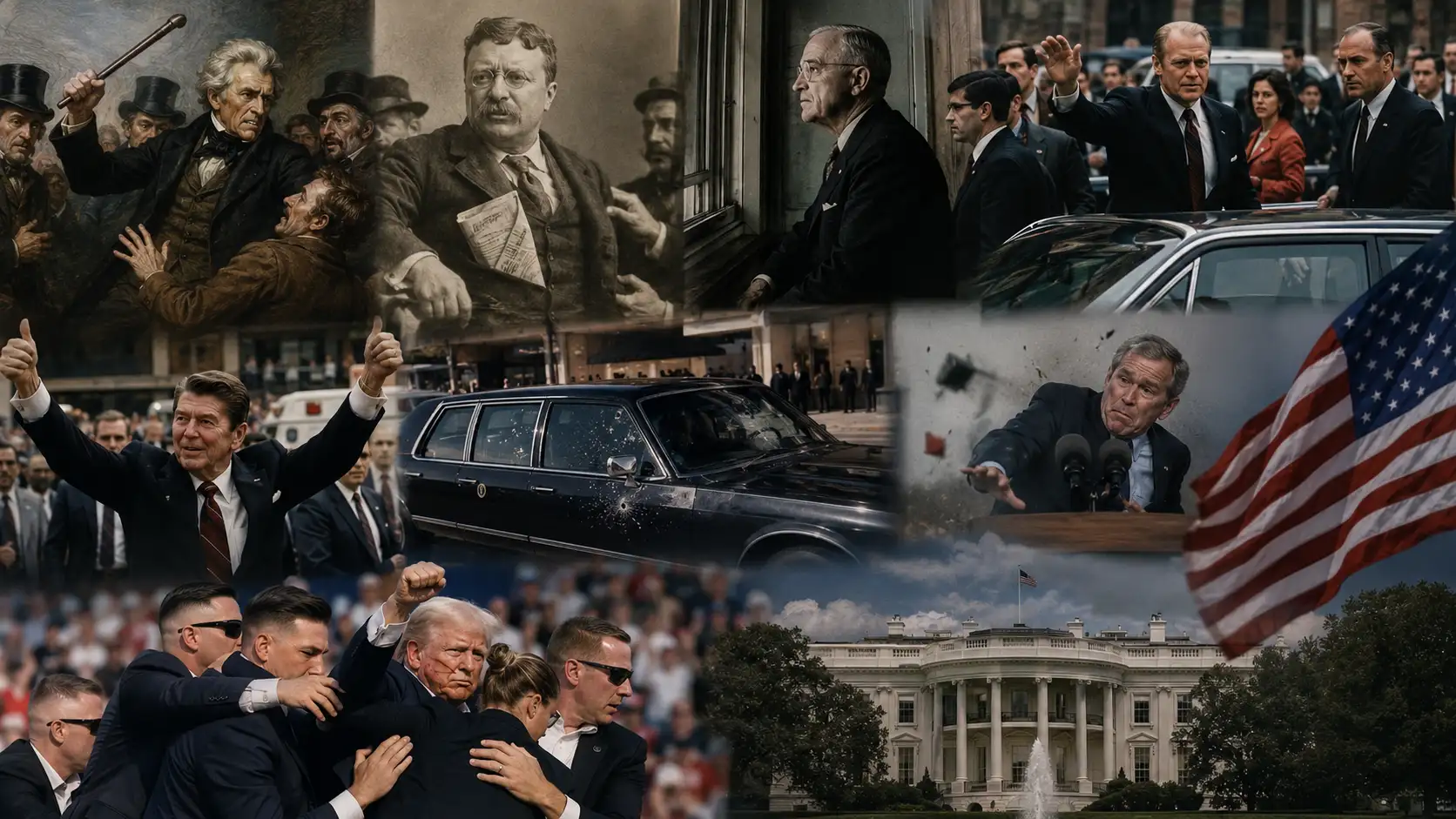
From the early days of the republic to the modern Secret Service era, these failed assassination attempts have shaped not only individual presidencies but also the evolution of presidential security across the United States.
Nearly eight decades later, Theodore Roosevelt proved his legendary toughness during a 1912 campaign stop in Milwaukee. Running for a non-consecutive third term as the Progressive Party’s "Bull Moose" candidate, Roosevelt was shot in the chest by John Schrank. Fortunately, the bullet was slowed by a metal eyeglasses case and a dense, 50-page copy of his speech tucked into his jacket. After realising that he wasn’t coughing up blood, Roosevelt addressed the stunned crowd, declaring, "It takes more than that to kill a Bull Moose." Hen then went on to deliver his 90-minute speech before finally seeking medical treatment.
Close Calls in the Mid-Century: Harry S. Truman and Gerald Ford
In 1950, Harry S. Truman survived a violent attack on Blair House, where he was staying while the White House was undergoing renovations. Two Puerto Rican nationalists attempted to storm the residence, triggering a fierce gunfight on the front steps. The clash claimed the lives of a White House police officer and one of the attackers. Truman, who watched the incident unfold from a second-story window, escaped unharmed but was deeply affected by the sacrifice of the officers protecting him.
From the early days of the republic to the modern Secret Service era, these failed assassination attempts have shaped not only individual presidencies but also the evolution of presidential security across the United States.
The Miraculous and the Bizarre: Andrew Jackson and Theodore Roosevelt
The first recorded attempt on a sitting U.S. President took place in 1835, when Andrew Jackson became the target. As he was leaving a congressional funeral at the U.S. Capitol, an unemployed house painter named Richard Lawrence pulled out a pistol and fired - but it misfired. Lawrence immediately drew a second pistol, which also failed to fire. Experts later calculated the odds of both functioning weapons misfiring one after the other at nearly 125,000 to 1. Furious, 67-year-old Jackson reportedly attacked Lawrence with his cane before aides and bystanders restrained the would-be assassin.Nearly eight decades later, Theodore Roosevelt proved his legendary toughness during a 1912 campaign stop in Milwaukee. Running for a non-consecutive third term as the Progressive Party’s "Bull Moose" candidate, Roosevelt was shot in the chest by John Schrank. Fortunately, the bullet was slowed by a metal eyeglasses case and a dense, 50-page copy of his speech tucked into his jacket. After realising that he wasn’t coughing up blood, Roosevelt addressed the stunned crowd, declaring, "It takes more than that to kill a Bull Moose." Hen then went on to deliver his 90-minute speech before finally seeking medical treatment.
Close Calls in the Mid-Century: Harry S. Truman and Gerald Ford
In 1950, Harry S. Truman survived a violent attack on Blair House, where he was staying while the White House was undergoing renovations. Two Puerto Rican nationalists attempted to storm the residence, triggering a fierce gunfight on the front steps. The clash claimed the lives of a White House police officer and one of the attackers. Truman, who watched the incident unfold from a second-story window, escaped unharmed but was deeply affected by the sacrifice of the officers protecting him.
Next Story