
How Yoga Travelled from Ancient India to Every Corner of the World

The word yoga appears in the Rigveda, one of the oldest known texts in any language, but what it described then bears little resemblance to what fills studios across the world today. The earliest yoga was not about postures. It was about yoking the mind, the Sanskrit root yuj means to join or to harness, and the physical practices that dominate modern yoga are, in historical terms, a relatively recent branch of a much older tree.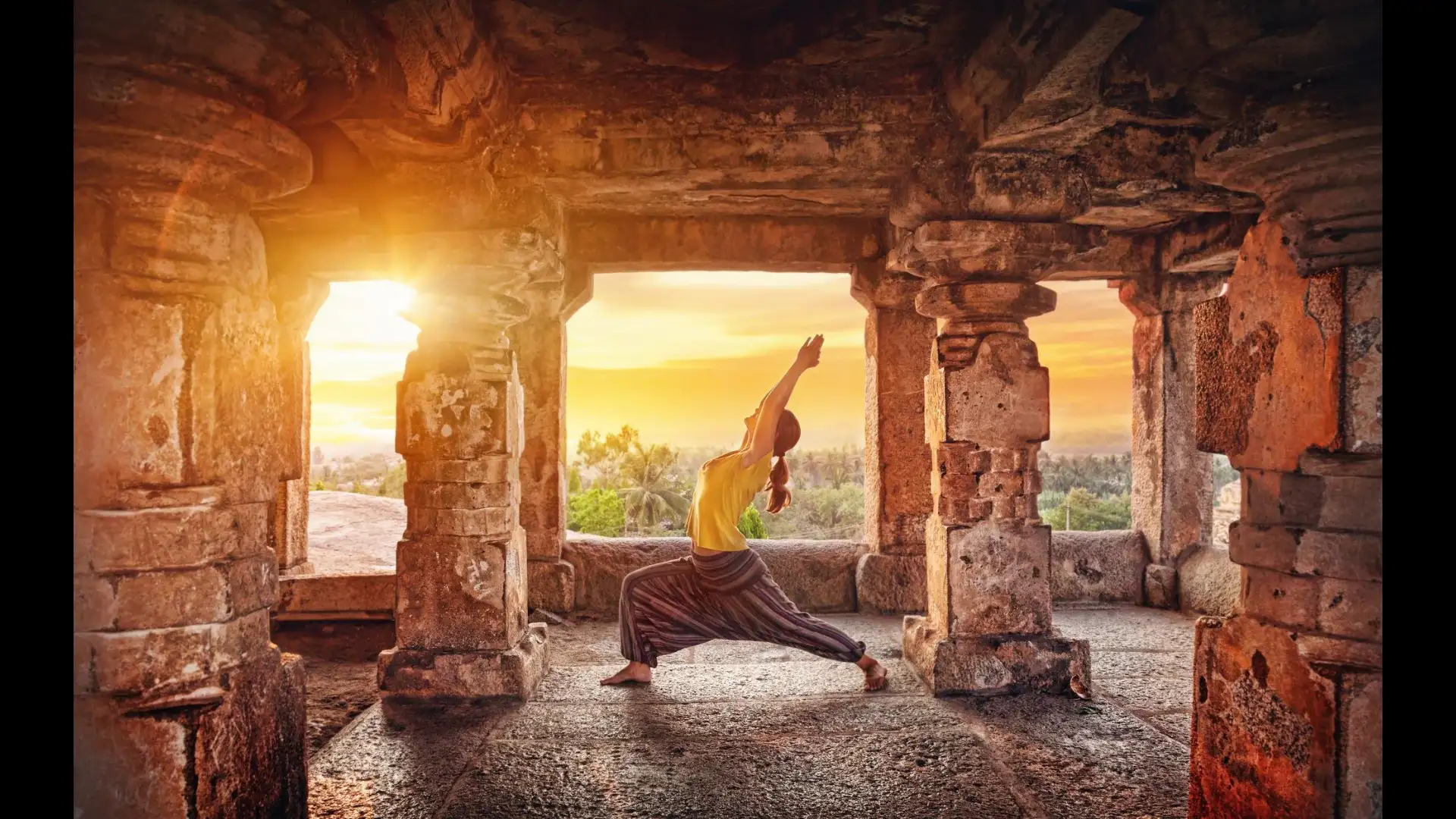
Hatha yoga, the tradition that gave the world its repertoire of physical postures, developed later, through texts like the Hatha Yoga Pradipika written in the fifteenth century. Hatha practice used the body deliberately: specific poses, breath techniques, and internal locks were understood as tools for preparing the nervous system for deeper states. The tradition was kept alive in lineages of wandering ascetics and in the courts of rulers who supported learned teachers.
In the decades that followed, a handful of teachers carried physical practice westward. Tirumalai Krishnamacharya, working in Mysore in the early twentieth century, developed a vigorous, sequenced style of asana practice that he taught to students who would later become the most influential teachers in the modern world. B.K.S. Iyengar, Pattabhi Jois, and Indra Devi all trained under him. Each took a distinct strand of his teaching and carried it abroad, Iyengar to Europe, Jois to America, Devi to Argentina and then California.
Yoga studios began appearing in American and European cities through the 1970s, often attached to health food stores and the broader alternative-health movement.
The physical fitness boom of the 1980s gave yoga a second wave. Stripped of much of its philosophical context and reframed as a form of exercise and stress relief, it entered gyms, television programmes, and corporate wellness schemes. This secularised version spread faster precisely because it asked less of its practitioners. Whether this diluted the tradition or democratised it remains a genuinely contested question among scholars and practitioners.
The Indian government's active promotion of yoga as a form of cultural diplomacy has since made it a regular feature of Indian embassies and cultural centres worldwide.
Digital platforms removed the last geographic barrier. A teacher in Pune can reach a student in Peru. Styles that once required a trip to India, Iyengar, Ashtanga, Kundalini, Sivananda, are now accessible to anyone with a screen and a mat. This has created a genuinely global conversation about the practice, including sharp debates about cultural appropriation, commercial distortion, and who profits when a tradition travels far from its source.
The philosophical vocabulary has also proved durable. Words like prana, chakra, and dharma have entered common speech in languages that had no equivalent terms, which is itself a measure of how completely the tradition has embedded itself in cultures far from its origin. Whether those words carry their original meaning in their new homes is a separate question, and one that Indian scholars, diaspora communities, and Western practitioners continue to argue about with genuine heat.
Yoga left India as a discipline for renunciates and arrived in the rest of the world as almost everything else: therapy, sport, spiritual practice, fitness regime, and philosophy. The tradition is old enough to have survived many such transformations before. What it becomes next will be shaped, as it always has been, by the people who practise it and the questions they bring to the mat.
The Classical Roots
The philosopher Patanjali organised the principles of yoga into 196 aphorisms, known as the Yoga Sutras, somewhere between the second century BCE and the fourth century CE. Patanjali described eight limbs: ethical restraints, personal observances, posture, breath control, withdrawal of the senses, concentration, meditation, and absorption. Asana, the limb that modern practice has made central, received only a handful of lines. Patanjali's definition of a posture was simply that it be steady and comfortable, a seat for meditation, nothing more.Hatha yoga, the tradition that gave the world its repertoire of physical postures, developed later, through texts like the Hatha Yoga Pradipika written in the fifteenth century. Hatha practice used the body deliberately: specific poses, breath techniques, and internal locks were understood as tools for preparing the nervous system for deeper states. The tradition was kept alive in lineages of wandering ascetics and in the courts of rulers who supported learned teachers.
The First Crossings
Yoga's earliest international encounters were philosophical rather than physical. When Swami Vivekananda addressed the Parliament of the World's Religions in Chicago in 1893, he spoke about Vedanta and the unity of religious experience. He did not teach sun salutations. But the response to his lectures was electric, and he spent years afterwards travelling across the United States and Europe, planting the idea that Indian philosophy held something the West had not yet found. Vivekananda's visit is the moment most historians mark as the opening of yoga's outward journey.In the decades that followed, a handful of teachers carried physical practice westward. Tirumalai Krishnamacharya, working in Mysore in the early twentieth century, developed a vigorous, sequenced style of asana practice that he taught to students who would later become the most influential teachers in the modern world. B.K.S. Iyengar, Pattabhi Jois, and Indra Devi all trained under him. Each took a distinct strand of his teaching and carried it abroad, Iyengar to Europe, Jois to America, Devi to Argentina and then California.
You may also like
- China's mega hydropower projects in earthquake-prone Tibet spark safety concerns
- Not used since the Korean War; US Army practices digging mass battlefield graves, 'If we went to war tomorrow...'
- US midterms 2026: Vivek Ramaswamy outlines 7 executive orders he would sign on 'day 1' as Ohio governor
- Heirs of Jewish banker have sued Sotheby's over £1.2m painting sale, claiming artwork was looted by Nazis during World War II; a Parisian court to soon give ruling
- California Halloween store shooting leaves one dead, six injured; suspect on loose
The Counterculture Acceleration
The 1960s changed the speed of transmission entirely. When the Beatles travelled to Rishikesh to study Transcendental Meditation with Maharishi Mahesh Yogi in 1968, the global press followed. What had been the interest of a small, earnest minority became visible to an enormous audience almost overnight.Yoga studios began appearing in American and European cities through the 1970s, often attached to health food stores and the broader alternative-health movement.
The physical fitness boom of the 1980s gave yoga a second wave. Stripped of much of its philosophical context and reframed as a form of exercise and stress relief, it entered gyms, television programmes, and corporate wellness schemes. This secularised version spread faster precisely because it asked less of its practitioners. Whether this diluted the tradition or democratised it remains a genuinely contested question among scholars and practitioners.
How It Travels Now
The United Nations designating June 21 as International Day of Yoga gave the practice an official global platform that no single teacher or movement could have manufactured. The first observance in 2015 saw mass sessions held in dozens of countries simultaneously.The Indian government's active promotion of yoga as a form of cultural diplomacy has since made it a regular feature of Indian embassies and cultural centres worldwide.
Digital platforms removed the last geographic barrier. A teacher in Pune can reach a student in Peru. Styles that once required a trip to India, Iyengar, Ashtanga, Kundalini, Sivananda, are now accessible to anyone with a screen and a mat. This has created a genuinely global conversation about the practice, including sharp debates about cultural appropriation, commercial distortion, and who profits when a tradition travels far from its source.
What Survived the Journey
The breath is the thread that connects every version of yoga, from a Vedic chant to a power-flow class in Berlin. However far the form has travelled from Patanjali's eight limbs, the insistence on linking movement to breath has stayed. Teachers in traditions as different as Iyengar and Kundalini describe breath as the thing that separates yoga from gymnastics.The philosophical vocabulary has also proved durable. Words like prana, chakra, and dharma have entered common speech in languages that had no equivalent terms, which is itself a measure of how completely the tradition has embedded itself in cultures far from its origin. Whether those words carry their original meaning in their new homes is a separate question, and one that Indian scholars, diaspora communities, and Western practitioners continue to argue about with genuine heat.
Yoga left India as a discipline for renunciates and arrived in the rest of the world as almost everything else: therapy, sport, spiritual practice, fitness regime, and philosophy. The tradition is old enough to have survived many such transformations before. What it becomes next will be shaped, as it always has been, by the people who practise it and the questions they bring to the mat.






Loving Newspoint? Download the app now
