
Infrastructure and Economy: The Growing Economic Divide Across the Line of Control

Seven years after the abrogation of Article 370 in August 2019, an empirical look across the Line of Control (LoC) highlights a dramatic structural contrast. While Indian Jammu and Kashmir (J&K) is undergoing an unprecedented economic renaissance driven by mega infrastructure investments, Pakistan-occupied Jammu and Kashmir (PoK) remains caught in chronic economic stagnation, resource exploitation, and violent civil unrest.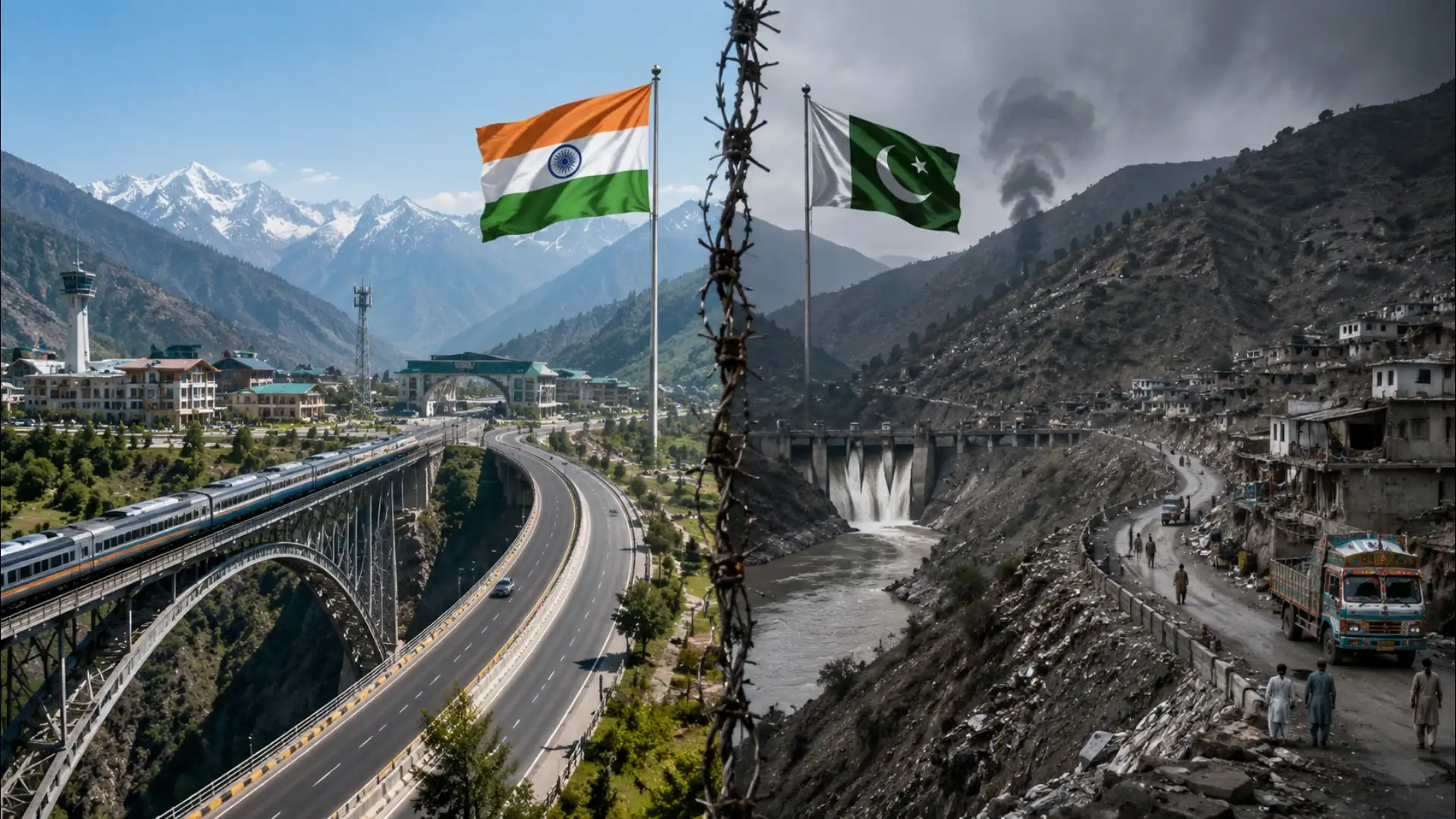
The trajectory of these two neighbouring regions demonstrates how contrasting governance approaches and economic integration can shape the daily lives of millions.
In sharp contrast, PoK suffers from a total absence of railway infrastructure. Local populations rely almost entirely on narrow, poorly maintained, and landslide-vulnerable road networks that hamper commerce and mobility.
Conversely, PoK’s total economic output lingers at roughly 6 billion US dollars—less than one-fifth of J&K’s economy. Plagued by Pakistan’s wider macroeconomic pressures, PoK functions largely as a resource supplier rather than a self-sustaining economy. Major hydroelectric developments like the Mangla Dam and Neelum-Jhelum projects generate vast electricity for Pakistan's industrial hubs in Punjab. Yet, local residents in PoK face severe power shortages, enduring up to 12 to 14 hours of daily load shedding alongside soaring electricity bills.
Furthermore, the region exhibits stark differences in disaster response capabilities. Modernized J&K has established early warning systems and climate-resilient infrastructure. In contrast, PoK lacks fiscal autonomy and emergency equipment, leaving mountain communities vulnerable during natural disasters like flash floods and severe landslides.
The trajectory of these two neighbouring regions demonstrates how contrasting governance approaches and economic integration can shape the daily lives of millions.
Infrastructure and Connectivity as Growth Engines
The fundamental difference between both sides lies in physical connectivity and state investment. In J&K, large-scale modernization projects have integrated the Union Territory directly into India's national economy. Engineering achievements like the Chenab Bridge , the highest railway bridge in the world, now connect the Kashmir Valley to the broader Indian railway network. Complementing this rail link are high-speed all-weather highways, modernized airport hubs, and nationwide 5G telecommunications.You may also like
- J&K, Ladakh have entered 'a decisive new chapter': PM Modi on Article 370 anniversary
- Remove deepfake content linking Gadkari to E20 program: Bombay HC
- Supreme Court to decide Maharashtra 2-child local election ban
- 'Vile, abusive': Bombay HC orders takedown of fake posts targeting Gadkari over E20 ethanol row
- Government forms 12-member panel to review NEET-PG amid SC probe
In sharp contrast, PoK suffers from a total absence of railway infrastructure. Local populations rely almost entirely on narrow, poorly maintained, and landslide-vulnerable road networks that hamper commerce and mobility.
Economic Divergence: Growth Versus Stagnation
The economic figures clearly illustrate this growing divide. Post-2019 administrative reforms in J&K streamlined red tape, attracting private investment and fostering a rising start-up culture. Consequently, J&K's Gross State Domestic Product (GSDP) has surged toward an estimated 30 billion US dollars (approximately Rs 2.65 lakh crore), maintaining a healthy real growth rate of over 7 percent.Conversely, PoK’s total economic output lingers at roughly 6 billion US dollars—less than one-fifth of J&K’s economy. Plagued by Pakistan’s wider macroeconomic pressures, PoK functions largely as a resource supplier rather than a self-sustaining economy. Major hydroelectric developments like the Mangla Dam and Neelum-Jhelum projects generate vast electricity for Pakistan's industrial hubs in Punjab. Yet, local residents in PoK face severe power shortages, enduring up to 12 to 14 hours of daily load shedding alongside soaring electricity bills.
Protests, Widespread Unrest, and Disaster Preparedness
This resource drain and inflation have sparked intense public backlash. Over the past year, massive civic protests organized by civil rights groups have erupted across PoK towns such as Muzaffarabad, Rawalkot, Mirpur, Kotli, and Poonch. Citizens are demanding basic living needs, including fair wheat flour prices and affordable utility rates. Tragic clashes with paramilitary forces in July 2026 alone resulted in approximately 70 deaths and over 300 injuries.Furthermore, the region exhibits stark differences in disaster response capabilities. Modernized J&K has established early warning systems and climate-resilient infrastructure. In contrast, PoK lacks fiscal autonomy and emergency equipment, leaving mountain communities vulnerable during natural disasters like flash floods and severe landslides.
A Changing Regional Reality
Ultimately, the widening divide across the LoC underscores how sustained capital investment and institutional integration create long-term stability. As J&K consolidates its economic gains within one of the world's fastest-growing economies, PoK’s ongoing crisis highlights the severe limits of political rhetoric when unbacked by local development.





Loving Newspoint? Download the app now
